

Dedicated vs Colocation Servers: Understanding the Key Differences
In this blog, we will explore dedicated servers and colocation servers, focusing on when to use each and their key differences. Previously, we examined VPS and cloud servers. Now, let’s look at the main use cases of dedicated and colocation servers, and learn how to choose the right option for your needs. To begin, let’s review the basics of a dedicated server.
What is a dedicated server?


A dedicated server solely serves a user. That is the basic understanding of a dedicated server. Users can utilize it for memory, CPU, disk space, bandwidth, and everything is completely dedicated to them, without sharing it with other users.
The hosting provider manages and maintains these physical server resources and allocates them to customers as per their requirements. Customers often call this server a bare metal server.
These physical servers are isolated digital servers, meaning they provide isolated physical server environments that you configure and manage as per your requirements. Users mainly use all of this for mission-critical applications that require high availability and compute-intensive workloads, where the application demands significant server resources.
Why and when do we choose a dedicated server?
You choose dedicated servers mainly when you have high-performance workloads and do not share physical hardware resources with other users. This makes your work more efficient and resource-intensive.
Also, the hosting provider gives dedicated servers with root access, so you can install any type of software and configure the server without their support. You can tune the server as per the requirements of the application or the website that you are going to host on that server. You can also monitor the load, network activities, and memory usage of the server.
If you require backups for your work, dedicated servers usually have huge disk space available to store backups. You can also use dedicated servers for gaming purposes, where you can host multiplayer online games, offering low latency and high performance.
Additionally, you can divide a dedicated server using virtualization tools to serve different clients within your working environment.
What is a colocation server?
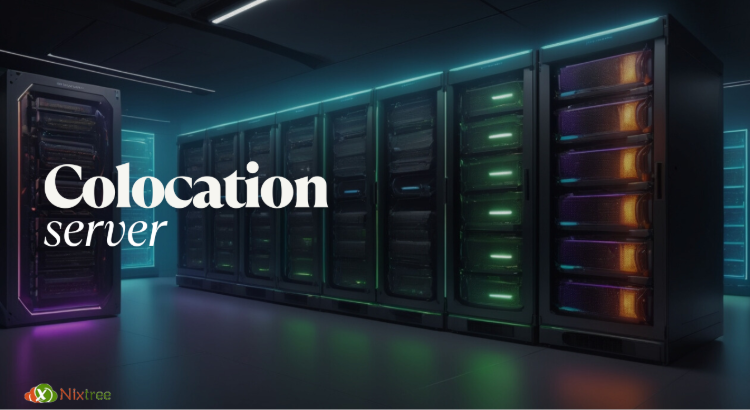
A business deploys and hosts its own physical server in a rented space inside a data center in the colocation server hosting model. In this process, the data center provides only the infrastructure, while the customer fully owns the server hardware.
The data center provides physical space, power supply, internet connectivity, bandwidth, cooling, and security to deploy the server. However, the customer or client organization remains the owner of the server.
In server colocation, the customer has full control over the server, including the operating system, software applications, and all services running on it.
The client business organization retains ownership of the server, but a managed service provider can maintain, manage, and monitor it if required. The server owner can access the server over the internet or through private network connectivity.
The main objective of server colocation is to control operational costs while utilizing enhanced information technology support services. The infrastructure and services provided by the data center achieve this. The data center also provides the servers with IP addresses, security, bandwidth, power backup, and customized backup solutions in addition to support services.
Why and When Do We Choose a Colocation Server?
We choose a colocation server because it requires a one-time investment to purchase the server hardware. After that, the organization only pays the monthly rental fees for space, power, and infrastructure in the data center. In comparison, the price of a dedicated server lease is higher in the long term because the organization rents the server instead of only the space.
A dedicated server requires monthly or yearly payments, while colocation mainly requires the one-time payment for the server and ongoing rental for the space. Businesses usually prefer colocation when they want long-term cost savings and full control over their infrastructure. It also suits organizations that plan to use the same hardware for a long time.
Conclusion
These are the basic details you need to understand the difference between a dedicated server and a colocation server. You can choose the right option based on your needs and preferences. We provide services for all types of servers, including server management, server hardening, and complete hosting support. If you are interested, you can check our website (nixtree) and select a suitable plan according to your requirements.